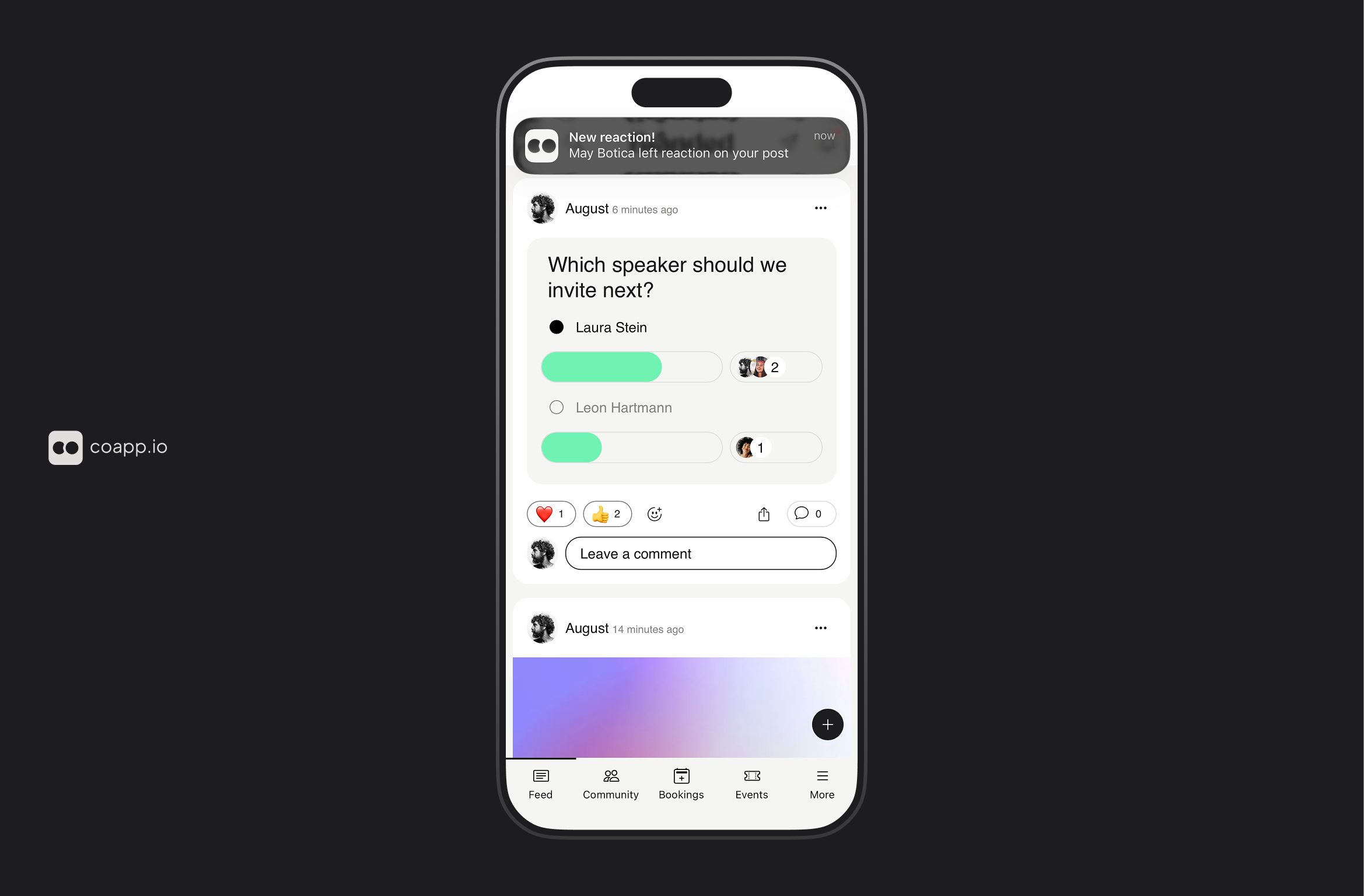
Creating Surveys with the coapp Community Platform
People looking for the best community platform are often asking the wrong question. After all, there is no such thing as the best community platform.
The right platform depends on the type of community you want to build. Are you looking for a solution for coaching and memberships? For an association? For a B2B community? Or for a coworking space with an active membership base?
Would you like to sell courses and content?
Would you like to build a member community?
Are you looking for an alternative to Facebook groups or WhatsApp?
Or would you like to create a genuine peer network where members can communicate with one another, organize events, and build long-term relationships?
Depending on your goals, different platforms may be suitable. In this comparison, we present the most important community platforms for 2026 and highlight the use cases for which they are particularly well-suited.
What makes a good community platform?
Many comparisons focus exclusively on Features.
The key question here isn't which platform offers the most features, but which platform supports your community's goals.
Important criteria include, among others:
Opportunities for networking among members
User-generated content
User-Generated Events
Memberships and Monetization
Data Protection and GDPR Compliance
data sovereignty
Mobile use
White Label and Private Label
Integrations with existing systems
It is particularly important to distinguish between platforms for creators and platforms for genuine communities.
Community platform or creator platform?
Many platforms were originally developed to allow coaches, creators, or experts to sell content, courses, and memberships.
The focus is usually on the relationship between the operator and its members.
Community platforms also support this approach. The difference, however, lies in the role of the members:
On many creator platforms, the focus is on the operator's content, programs, or offerings.
With community platforms, members can—if they wish—contribute their own content, events, projects, knowledge, or offerings. This creates not only an audience, but a genuine network.
The added value thus stems not only from the operator's content, but also from networking, exchanges, recommendations, collaboration, and relationships among members.
For organizations, associations, educational providers, networks, or community-led businesses, it is precisely this difference that is often crucial: They don’t just want to provide content; they want to build a vibrant community that takes action on its own.
Comparison of the Leading Providers
| Function | coapp | Skool | Circle | Mighty Networks | Heartbeat | Heylo | Bettermode | Hivebrite |
|---|---|---|---|---|---|---|---|---|
| Hosting and processing exclusively within the EU | Fulfilled | Not publicly disclosed as being based exclusively in the EU | Not publicly disclosed as being based exclusively in the EU | Not publicly disclosed as being based exclusively in the EU | Not publicly disclosed as being based exclusively in the EU | Not publicly disclosed as being based exclusively in the EU | Not publicly disclosed as being based exclusively in the EU | GDPR-focused, but not publicly identified as exclusively EU-based |
| Free trial available | Fulfilled | Free trial available | Free trial available | Free trial available | Free trial available | Fulfilled | Free trial available | No free trial option publicly advertised |
| Custom Branding & White Label Available | Fulfilled | Limited support | Fulfilled | Fulfilled | Fulfilled | Limited support | Fulfilled | Fulfilled |
| Custom-branded mobile app available | Fulfilled | Not disclosed publicly | Fulfilled | Fulfilled | Limited support | Not disclosed publicly | Not disclosed publicly | Fulfilled |
| Sell memberships | Fulfilled | Fulfilled | Fulfilled | Fulfilled | Fulfilled | Fulfilled | Limited support | Fulfilled |
| Organize events | Fulfilled | Fulfilled | Fulfilled | Fulfilled | Fulfilled | Fulfilled | Limited support | Fulfilled |
| A Focus on Peer-to-Peer Networking | Fulfilled | Limited support | Limited support | Fulfilled | Fulfilled | Fulfilled | Limited support | Fulfilled |
The information is based on publicly available data provided by the service providers at the time of publication. The scope of functionality, prices, and availability of individual features are subject to change. For Features EU-only hosting, white-labeling, and branded apps, availability and scope may vary depending on the pricing plan or individual agreement.
Skool vs. coapp
Skool is one of the best-known platforms for coaches, creators, and course providers. The platform combines a community, courses, and gamification in a simple user interface and is primarily aimed at people who want to share their knowledge with a community in a structured way.
Skool is a popular solution for creators who want to sell courses, provide educational content, and build a community around their expertise.
coapp also supports this approach. However, it places greater emphasis on building active networks in which members not only consume content but also build relationships, organize events, form groups, and learn from one another.
While Skool often focuses on learning content and courses, coapp combines community, events, memberships, bookings, and payments all in one platform.
When is Skool a better fit?
Skool is particularly well-suited for:
Creators and Coaches
Course-Based Communities
Digital Learning Programs
Memberships centered around a person or brand
Communities with a strong focus on content and learning
When is coapp a better fit?
coapp is particularly well-suited for:
Coaching and membership communities with active interaction among members
Associations, Networks, and Initiatives
Communities with events and local activities
Community-Led Businesses
Communities that want to offer networking, events, and memberships in addition to content
Heylo vs. coapp
Heylo was developed specifically for local communities, groups, and events. The platform supports the organization of meetings, activities, and local networks, and places great emphasis on interaction among members.
This makes Heylo particularly well-suited for communities that also meet regularly in person.
coapp takes a broader approach. In addition to events andFeatures , organizationsFeatures also manage memberships, publish content, book resources, and monetize community offerings.
When is Heylo a better fit?
Heylo is particularly well-suited for:
Local Communities
Event Groups
Recreational Groups
Organizations with a regional focus
Communities that primarily organize events
When is coapp a better fit?
coapp is particularly well-suited for:
Networks and Initiatives
Coworking Spaces and Physical Locations
Communities with Memberships
Communities with their own content and knowledge resources
Organizations that want to combine community, events, and monetization
Heartbeat vs. coapp
Heartbeat positions itself as a modern platform for professional communities and digital networks. In addition toFeatures , the platformFeatures chats, events, member directories, and networking opportunities.
Heartbeat is an attractive solution, especially for digital memberships, business communities, and online networks.
While Heartbeat focuses primarily on digital communities and networking, coapp also supports community-based business models. In addition to communication and events, organizations can also manage memberships, book resources, process payments, and monetize community offerings.
This makes coapp particularly well-suited for organizations that view the community not just as a communication channel, but as a central component of their offerings or business model.
When is Heartbeat a better choice?
Heartbeat is particularly well-suited for:
Digital Networking Communities
Membership Communities
Business Networks
Online-First Communities
Professional communities focused on knowledge sharing
When is coapp a better fit?
coapp is particularly well-suited for:
Corporate & B2B Communities
Associations, Networks, and Initiatives
Coworking Spaces and Physical Locations
Communities with events, bookings, and resources
Organizations that want to integrate community, memberships, and payments into a single platform
Circle vs. coapp
Circle is one of the best-known platforms for memberships, creator communities, and digital learning offerings. The platform combines community features, courses, events, and paid content in a modern user interface.
For creators, coaches, and companies looking to set up digital memberships or learning programs, Circle is one of the established solutions on the market.
coapp also supports communities with events, memberships, and content. However, its focus is more on long-term networks where members can take the initiative, build relationships, and create offerings such as workshops, knowledge-sharing opportunities, or surveys within the community.
coapp brings together community, events, bookings, payments, and memberships on a single integrated platform, under your own brand.
When is Circle a better fit?
Circle is particularly well-suited for:
Creator Communities
Premium Memberships
Digital Courses
Content Communities
Brands Focused on Digital Offerings
When is coapp a better fit?
coapp is particularly well-suited for:
Associations, Networks, and Initiatives
Community-Led Businesses
Communities with local and digital events
Coworking Spaces and Physical Locations
Organizations that want to consolidate their community, memberships, bookings, and payments onto a single platform
Mighty Networks vs. coapp
Mighty Networks combines communities, courses, events, and memberships into a single platform and is primarily aimed at creators, coaches, and digital community managers.
Mighty Networks is particularly well known for its mobile user experience and the ability to create custom community apps.
For communities with a strong focus on content, courses, and memberships, Mighty Networks is an interesting option.
coapp places greater emphasis on building active peer networks where members can interact with one another, organize events, share resources, and develop community initiatives.
When is Mighty Networks a better fit?
Mighty Networks is particularly well-suited for:
Creators and Coaches
Digital Memberships
Learning Communities
Online Programs
Communities with a strong focus on content
When is coapp a better fit?
coapp is particularly well-suited for:
Networks and Associations
Coworking Spaces
Community-Led Businesses
B2B and Corporate Communities
Communities with events, resources, and active member participation
Bettermode vs. coapp
Bettermode was originally developed for brand, customer, and product communities. The platform offers extensive customization options and is particularly well-suited for support portals, knowledge bases, and customer communities.
Many companies use Bettermode to encourage interaction among customers and improve support processes.
coapp is geared more toward communities that focus on networking, events, memberships, and community activities.
When is Bettermode a better fit?
Bettermode is particularly suitable for:
Customer Communities
Product Communities
Support Forums
Knowledge Bases
SaaS companies focused on customer success
When is coapp a better fit?
coapp is particularly well-suited for:
B2B Communities
Industry Networks
Organizations and Initiatives
Membership Communities
Organizations that want to combine community building with events and memberships
Hivebrite vs. coapp
Hivebrite is one of the leading platforms for associations, alumni networks, nonprofits, and professional communities. The platform offers a wide range of Features member management, directories, networking, and community management.
Larger organizations with complex needs, in particular, use Hivebrite to manage their members and build professional networks over the long term.
coapp is also aimed at associations, networks, and community organizations. However, it places a stronger emphasis on community engagement, events, interaction, and a quick start without lengthy implementation projects.
While Hivebrite is often used by established organizations with complex structures, coapp is particularly well-suited for organizations that are building their community step by step and want to consolidate events, memberships, communication, and payments into a single platform.
When is Hivebrite a better fit?
Hivebrite is particularly well-suited for:
Alumni Networks
International Associations
Nonprofit Organizations
Large professional communities
Organizations with complex membership structures
When is coapp a better fit?
coapp is particularly well-suited for:
Associations, Networks, and Initiatives
Community-Led Businesses
Corporate & B2B Communities
Coworking Spaces and Physical Locations
Educational Providers, Coaching Programs, and Memberships
Organizations that want to get started quickly and actively grow their community
Free Messaging Apps and Social Networks vs. Proprietary Community Platforms
Many communities get started on platforms like WhatsApp, Facebook, or LinkedIn. It’s easy to get started, the audience is already there, and most members use these services every day anyway.
This is often more than enough for discussions in small groups.
However, as these platforms grow in size and face increasing demands, they often reach their limits. Knowledge gets lost in chats or timelines, events must be organized using additional tools, and there are limitations on managing memberships or paid offerings.
A dedicated community platform takes a different approach: It creates a central hub for communication, knowledge, events, memberships, and collaboration — under your own brand and with full control over the community.
WhatsApp Communities vs. coapp
WhatsApp communities are often the easiest way to start building a community. Almost everyone already uses WhatsApp, and new groups can be created in just a few minutes.
WhatsApp is ideal for quick communication, announcements, or discussions in smaller groups.
However, as a community grows, new requirements often arise. Information needs to remain accessible over the long term, events need to be organized, members need to be managed, and additional services need to be provided.
This is where a messaging app naturally reaches its limits.
While WhatsApp is primarily used to organize conversations, a community platform provides a central hub for the entire community. With coapp, for example, you can organize events, create groups, manage memberships, and monetize offerings—all under your own brand.
WhatsApp is particularly well-suited for: quick communication and small groups
Facebook Groups vs. coapp
Facebook groups make it easy to get started quickly and affordably. They’re a particularly straightforward way to reach and connect with existing Facebook users.
At the same time, the community remains part of the Facebook platform. Visibility, reach, and user experience are influenced by Facebook's terms and conditions.
For many communities, this isn't a problem. However, those who want to build an independent community over the long term often seek greater control over members, content, and their own brand.
A community platform like coapp puts the community itself at the center. Content, events, memberships, and interactions all take place in one place—free from algorithms or ads.
Facebook Groups are particularly well-suited for: reach, visibility, and initial community activities
LinkedIn Groups vs. coapp
LinkedIn is one of the most important networks for professional contacts and B2B relationships. Groups can help connect people with similar interests or from similar industries.
However, the focus is on LinkedIn's professional network itself—not on building a standalone community.
If you're primarily looking for visibility, networking, and new contacts, LinkedIn is a great place to start. However, if you want to build an active community with its own events, memberships, content, or offerings, many organizations need their own digital hub.
With a community platform like coapp, relationships can be built over the long term and maintained independently of external platforms.
LinkedIn is particularly well-suited for: B2B networking and professional reach
When is a free platform no longer enough?
Having your own community platform becomes particularly appealing when:
Members should actively network with one another
Knowledge must be documented and remain accessible over the long term
Events are held regularly
Memberships to be managed
Content, events, or services that are to be monetized
the community becomes part of the business model
the platform is to be operated under its own brand
Free messaging apps and social networks are often a good place to start. However, if you want to build a sustainable community with long-term value, you’ll usually benefit from having your own community platform.
Why do organizations choose coapp?
Many platforms were originally developed for creators, courses, or digital memberships.
coapp takes a broader approach: The platform helps organizations build active community networks and generate long-term value from them.
Members can network, form groups, organize events, share knowledge, manage their memberships, and take advantage of community offerings—all within a single platform.
In addition, coapp combines community, communication, events, bookings, payments, and memberships into a single integrated solution.
For European organizations, GDPR compliance, data sovereignty, and hosting within the EU are also important advantages.
coapp is particularly well-suited for:
Associations, Networks, and Initiatives
Corporate & B2B Communities
Physical Locations & Coworking Spaces
Coaching & Memberships
Educational Providers
Community-Led Businesses
In addition, GDPR compliance, data sovereignty, and hosting within the EU play a particularly important role for organizations in Europe.
Data sovereignty and the GDPR are becoming increasingly important
Anyone who builds their own community platform is making a long-term investment in relationships with their members.
That's why you shouldn't just Features on Features .
Equally important are questions such as:
Who owns the data?
Where is the data stored?
Is the platform GDPR-compliant?
Can the community operate independently of algorithms?
Will our own brand remain the focus?
These issues are becoming increasingly important, especially for European companies, associations, and public organizations.
Which community platform is right for your goal?
Choosing the right community platform Features less on individual Features than on the type of community you want to build.
Many of the best-known platforms were originally developed for creators, coaches, and digital memberships. These platforms focus on content, courses, and the relationship between the platform operator and its members.
Other solutions focus on customer communities, support portals, or professional membership organizations.
On the other hand, if you want to build a community where members actively interact with one another, organize events, share knowledge, and build long-term relationships, you shouldFeatures specialFeatures to the networking andFeatures .
If your focus is on courses, content, and memberships, platforms like Skool, Circle, or Mighty Networks are often a good choice.
If you want to build a community for customers, support, or product feedback, solutions like Bettermode might be worth considering.
Alumni networks, large associations, or professional membership organizations should check out Hivebrite.
For organizations that want to offer more than just content or memberships, coapp takes a different approach. The platform combines community, events, memberships, communication, bookings, and payments into a single solution and supports the development of active networks among members. This makes coapp particularly well-suited for associations, networks, and initiatives; corporate and B2B communities; coworking spaces; and coaching and membership programs with high member engagement.
Conclusion
There is no such thing as the "best" community platform in 2026. However, there are platforms that have been developed for different purposes.
When content, courses, and memberships are the focus, platforms like Skool, Circle, and Mighty Networks are among the best-known solutions.
If you want to build a customer community, a support portal, or a product community, platforms like Bettermode may be the right choice.
For alumni networks, associations, or larger membership organizations, Hivebrite is a well-established solution with comprehensive management andFeatures.
The crucial question, therefore, is not:
"Which community platform has the most Features?"
Rather:
"What kind of community do I want to build?"
If your goal is to build an active network where members connect with one another, share knowledge, organize events, take advantage of opportunities, and build long-term relationships, you should choose platforms that were designed specifically for this purpose.
coapp consistently follows this approach. The platform combines community, events, memberships, communication, bookings, and payments into a single solution and helps organizations build active networks rather than mere content communities.
This makes coapp particularly well-suited for:
Associations, Networks, and Initiatives
Corporate & B2B Communities
Physical Locations and Coworking Spaces
Coaching and Membership Communities
Educational Providers and Community-Led Businesses
After all, the long-term value of a community rarely comes from content alone—but rather from the relationships, interactions, and collaboration among its members.
That's exactly why your choice of community platform shouldn't Features solely on Features , but on the kind of community you want to build in the long run.